Episode Transcript
[00:00:02] Speaker A: Welcome to Creative Places and Faces, the podcast that explores how places can affect our creativity and lives.
Irish author Jackie de Burke interviews artists, authors, and all sorts of creatives from around the world, travel virtually and explore the world creatively.
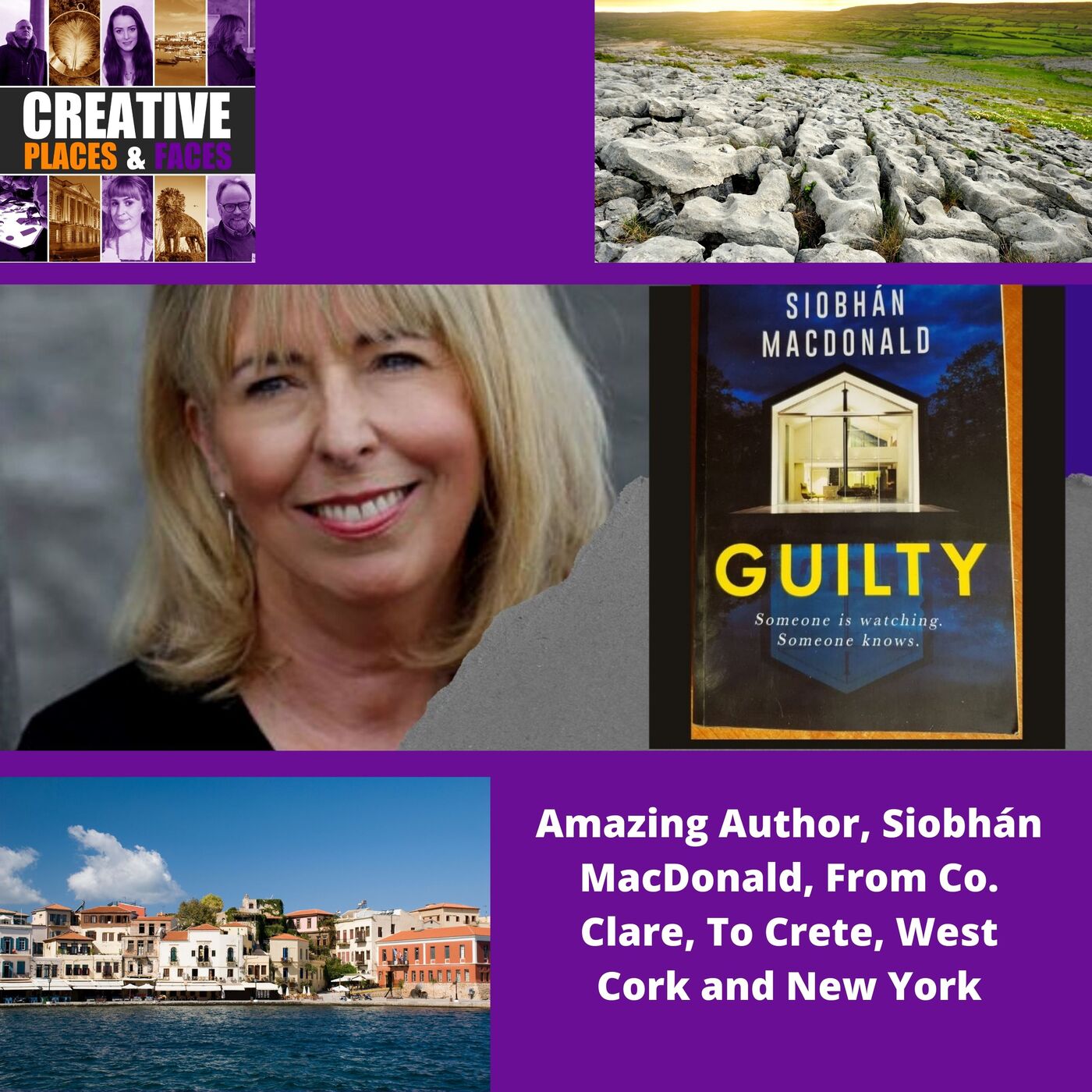
[00:00:30] Speaker B: I read the Third Night novel written by today's guest late last year, and I couldn't put it down. Guilty, which is set in County Clare, is a riveting page turner about the dark secret that causes a doctor's perfect life to unravel.
One review by the author Patricia Gibney stated, a full tapestry of secrets and lies. A perfect mix for a thrilling read. I loved Guilty. And so did I. And after reading it, I wasn't surprised to notice that our guest describes herself as a plotaholic. A very warm welcome to you, Siobhan McDonald. Thank you so much for joining us today.
[00:01:06] Speaker A: It's lovely to be with you, Jackie. Thank you for having me.
[00:01:09] Speaker B: Thanks, Siobhan. So listen, the temptation to roll out this quote frequently overcomes me. Siobhan, wherever you go becomes a part of you somehow. By Anita Desai what do you feel about this quote?
[00:01:23] Speaker A: I. Yeah, I mean, I agree with that. And I guess we kind of have an Irish View version of that, which might sometimes be a bit used disparagingly.
You can take the man or the woman out of the bog, but you can't take the bog out of the man or the woman. And I think really what that means in a broader sense is roughly what you're saying there. You know, where you've been becomes part of you.
And it reminds me very much of the themes that I tried to cover in the very first novel that I wrote, which is still in a drawer and I may read at some time.
And in the opening scene in this particular novel, I have a teacher in a classroom saying to the children, you can't know where you're going unless you know where you've been. And I think I was probably at the time I was influenced by Maya Angelou and that was one a phrase that she used to say, you can't know where you're going unless you know where you've been. So I think you bring your past with you, but you also leave a little bit of yourself behind wherever you've been as well. So, yes, I do agree with that.
[00:02:40] Speaker B: Brilliant answer. I love that answer. Siobhan. So what places have become a part of you in your own life to date?
[00:02:48] Speaker A: Well, I have spent the majority of my time in Ireland. I was born in Cork. I lived there for eight years, and then we Moved to Limerick.
I went to college in Galway, to Nuig, and I spent a lot of summer holidays around the west coast and the southwest coast. And then I left Ireland and I spent the bones of 10 years on and off in Scotland. And I spent a bit of time in the south of France as well. I spent a year working in the south of France.
So they're the places that I've spent, you know, long tranches of time, apart from holidays here and there.
[00:03:32] Speaker B: Okay. Okay, so you were the first eight years of your life in Cork and then you moved to Limerick. So let's talk about those, those, both of those environments, Siobhan. How did either or both of them influence your formative years?
[00:03:47] Speaker A: Well, I guess, you know where, where you grew up in your, your early years. I mean, everybody remembers their, their first day at school and their first friends and the first film that they went to book that they read. And I remember all of those from that Cork setting. I grew up in Bishopstown and I remember my mother bringing me to school.
And my memory of it, and she isn't around at the moment from, you know, she's passed on, but my memory of it is of her giving me a piggyback through a field full of BlackBerry bushes along to Scull and Sprit Nave, which was the name of the school in Bishopstown. And I remember that, that first day at school thinking, yes, well, this is all very well and it's lovely, but I don't think I'll come back again. It's a little bit boring. And.
And then, you know, you get to find out that actually, yes, you do have to come back again. But I lived. I grew up on a. Well, two housing estates. One of them was an old established estate and the second one was a new development. And I remember all the builders r being around and these like. They were almost like teepees with, I suppose it was builders, blocks and beams of wood. And just remember all that. The games that we played, you know, we would play cowboys and Indians and cops and robbers and all those kind of games that I suppose there are variations in that that kids play now. And it was a lot of outdoor play because the TV didn't start until 6 o' clock when I was very small. So you were out all the time and read would have been a big part of my life. I remember every Saturday going into. My mother would bring me into town and I would buy. I would get an Enid Blyton, which was what I had started off with every Saturday.
And then I remember the first film that I went to see, I think it was Bedknobs and Broomsticks in the. In the Cinnamon Cork and Patrick street. And we went to the Wimpy next door afterwards. So they were my. My early memories from Cork. And I remember the emphasis at the time in school was. And things have moved away from this philosophy. I guess they might come back at a certain stage, but it was really the three Rs, the reading, writing and arithmetic. And I remember our little spelling book. We would have an essential spelling list. It was a red book, and you'd have 20 spellings to learn off every week. And I remember writing my first essays in school.
And actually the teacher was horrified when she heard that I was going. Leaving Cork, because the notion that anybody would leave Cork was just anathema to her. She couldn't understand why anybody would leave, you know, the great Republic of Cork. And I was looking back on it. I mean, the. The city does very much have a sense of independence. And I think anything far away from. From the capital and outside the pale, they. Cork people do very much have an independent spirit. And I think you can kind of see that at the moment when they're commemorating the War of Independence and the Civil War and there's all these programs on TV at the moment about various military activities that happen down there. I think in a way, they happened around Cork more than in other places because they were so far outside the pale. And that kind of feeds itself into the psyche of a city as well. I think they're very proud, very independent people. And I think I left Cork with very much. With the sense. I was only 8, but I did leave with a sense of being a little Cork woman at the time.
And I do remember arriving in Limerick and people looking at me going, look at her with that mad Cork accent.
And again, Limerick has. Limerick has been extremely good to me. And it's a different feel of a place. It's smaller, some beautiful Georgian architecture, which, you know, hopefully we are going to retain and store.
But again, it felt more like even then to me, a big town rather than a city.
And I went to an all Irish school.
It was called Unmoscull, which was in a. I think the. The building at the time I went was possibly even, you know, 150, 180 years old. And we had this classroom with huge, big vaulted ceilings and a big kind of Gothic window that you could see the trees outside. And there was no central heating. And it might sound like the Dark Ages, but we. We actually had turns in the classroom to feed this. There was some kind of a turf burning oven in the classroom.
[00:08:48] Speaker B: Okay.
[00:08:49] Speaker A: Yeah. I mean, it sounds like the dark ages, but it was a very, very, very old building.
And again, it was mixed classes. You'd have two classes in there together. And the teachers that we had in there were fairly inspirational, I have to say. Again, it was a small school and I think you can do a lot when, when classes are small rather than. Yeah, yeah. If you move from, you know, for a 40 person class to maybe 20 person, you can, you can, you can do an awful lot more work. So that was my, my early years in Limerick. They're my early memories. Okay.
[00:09:24] Speaker B: I mean, I find it very interesting, separate to the environments and the story of the classroom there in Limerick, that you were educated in Gaelica in Irish for people who are not Irish. Do you feel, Siobhan, that learning a second language, which of course is our national language originally, do you feel that affected you creatively as a person at all?
[00:09:48] Speaker A: Oh, yes, definitely.
I think it opens up a part of your brain that you're not fearful then of learning other languages.
My father was a native Irish speaker. Now, he wasn't from Connemara or anything, he was from West Waterford, but his own father had learned Irish at the age of 30 in Ring College. And he brought his children up speaking Irish. And then my father. Father passed that down, his love of Irish down to me, even though, I mean, we came from a kind of a. An odd household in that my dad had this great love of Irish, but my mother was English and didn't have a word of Irish. So we kind of had the two traditions in our house.
[00:10:35] Speaker B: Interesting. Very interesting.
[00:10:36] Speaker A: Yeah. It was a bit like.
I remember reading Hugo Hamilton's book the Speckled People. And he describes this kind of having one German parent and one Irish parent and the two kind of trad mixing. It was very much like that in our house because my mother was very proud of her English heritage and my father was very proud of his Gaelic speaking Irish heritage. And, you know, you're not fearful then of learning another language, as I say, and the way it was taught, I think in certain schools probably didn't inspire a love of the language. But the way I was taught and having it at home didn't make it something to be feared. And then you had access to so many Irish stories that meant more to you when you could understand them. I remember reading I was at Torik Dermadagus Granja in leaving certain Peg Sayers and all those stories which everybody Else seems to hate the story of Pig Sayers. Whether.
Whereas I actually enjoyed reading those stories. I don't know whether that's a reflection on me or not, but I think having facility with Irish at that time now, it's very, very rusty. But, you know, it made these things more accessible to me, I think.
[00:11:49] Speaker B: I think. I think I would. I would agree. I did one year in Ring, so I would have not the same background to, To. To the extent that you do, Siobhan, but I would agree that it's a very interesting mix of languages and culture that you were growing up with. And I would imagine. Did it affect your creativity as a child? What kind of memories do you have of being a creative child?
[00:12:13] Speaker A: Well, I suppose because I enjoyed Irish. I enjoyed writing in Irish, and I used to write in my. Let's say, as a child. I Suppose I was 12, 13, 14.
I used to write poetry and that would be entered into competitions. There was a competition at the time, and I think it's maybe come to an end now. I don't think they operate anymore, but it was a sloga. And I used to write poetry for that. And also I used to write a dramatic duologues where I'd write a script to be acted on stage between two people and that they would be entered into competitions as well. And we used to. I remember going up to Dun Laoghaire and our Irish teacher bringing us up, and we would act out these little scenes on stage. So, you know, if nothing else, it was a great day out the big smoke.
And you, you know, so. So that was fun. And then later I.
I wrote an essay for the old Intersect, or as it used to be called in my day.
I remember. I don't remember the essay I actually wrote, but I did get recognition for it from the exam board for creativity. So I guess, you know, it struck a chord with. With some people. So, like, my. My first foray forays into creative writing were probably in Irish rather than. Rather than in English.
[00:13:45] Speaker B: That's so interesting. And tell me something, Siobhan.
Were there any family members or teachers that you have in your memory that were, you know, encouraging to you in this particular way?
[00:13:57] Speaker A: Oh, certain. I mean, I came from a very encouraging household.
My. Both my mum and dad always told, there are six of us in family.
And they always told us we could do and be anything we wanted to be.
My mother would have, you know, if we had wanted to be astronauts, she would have said, you know, go and do that. You're able to. She inspired confidence in Us. She was a. She was a hugely positive person, as was my father.
So my mother was always writing poems, little kind of palm air kind of ditties, as she would call them, and she would recite them and enter them into competitions and try and get on the radio with them because she came from a speech and drama background and she loved theatre and she loved any kind of drama.
So any kind of writing that I would do, she would encourage me along that route, as would my father. And then in school, I did have. I had teachers in primary and in secondary school. One particular teacher in the model school, her name was Breed Kalu, which is such an unusual name. And she.
Oh, she could speak French, she could speak Russian. She could.
She was really interested in theatre. And she inspired all of us in our writing in school.
And then in secondary school, I had an English teacher and an Irish teacher who were. Who were quite inspirational.
Our English teacher kind of taught us the rudiments of.
I suppose she did a lot of debating with us as well, and she taught us the art of arguing from the general to the particular.
And just a lot of. She did a lot of basics with us.
And I guess the. The curriculums in. In the schools at the time, I mean, they had wonderful materials to work with because we had these books called exploring English 1, 2 and 3. And they would cover all the, you know, that the. A lot of the poets, you know, the metaphysical poets, the Romantic poets, the Irish poets. So we, you know, we got a very good grounding in the basics of. Of English literature in school. And so. So it was a good curriculum. And as I say, yeah, these teachers were inspirational in terms of inspiring our creativity for essay writing and poetry writing and that kind of thing.
[00:16:38] Speaker B: Okay, I. I actually do remember those books. I think we're a similar age group, I think. Now tell me something on a slightly different note. What about family holidays? Did you head off to any places during your formative years as a family that sort of have stayed with you?
[00:16:55] Speaker A: Oh, yes, we.
For many years as a.
My earliest memories of going on holiday were down to Skull in West Cork, and we took a break from that for a while. We used to go to a house in Uchterard.
It's the gateway to come Guanamara, really. And then we came back to West Cork and spent many, many years down in Barley Cove. We used to go to. We'd all pack into this tiny wooden chalet at the side of a hill and overlooking a lagoon and the sea, and that's where we went for I don't know, more than 10 years, I would say at Easter time and maybe for six or seven weeks in the summer. So I look back with huge fondness at my time down in West Cork.
[00:17:50] Speaker B: I can imagine. So when we were in contact before today's interview, you used a wonderful phrase in connection with West Cork. You. You said, Siobhan, for the color therapy that it affords. Are colors especially important to you?
[00:18:06] Speaker A: I think that they are. I don't know.
I mean, it is a science. Color therapy is a kind of science. And I do. I love the color blue and I love all the variations of blue you can get from the sea and the sea down around West Cork, that part of the country can be, you know, vary from turquoise to an aqua to a navy blue. And there's something in that that makes. That lifts your spirits. And. I don't know, I mean, I remember one time and hearing Marian Finucan, who, may she rest in peace, who was a. An RTE radio broadcaster, and she once said, you know, I don't need to go on holiday. All I need to do is actually look at a brochure and look at the color of the sea. And I, too, now that we can't go on holiday at the moment with the virus.
Even looking at old photographs of holidays or any brochures you may have lying around, just to see that color blue. It does. It does lift the spirits.
[00:19:14] Speaker B: Yes, it definitely does. And going to something that you wrote in the Irish times again during, you know, the pandemic in 2020. In September of 2020, you said, as an island nation, many of us have a close affinity with water. I certainly do. My novels all have waterside settings. Twisted river, the Blue Pool, and now my latest thriller, Guilty, set on a lakeside in County Clare.
I have recently returned from a week by the sea in a tiny cottage on a remote part of the Mizzen Peninsula in West Cork. Now, I've asked other guests, Siobhan, about their connection with water. It's a theme that really fascinates me.
Tell me a bit about your very obvious connection with water, Siobhan.
[00:20:02] Speaker A: Well, I wonder if it comes from.
There's always a sense of mystery around water.
And in college I did electronic, well, engineering, and I remember part of the engineering course, we had to study hydraulics and we had to study, you know, the movement of water. And I remember one particular lecture where we were discussing how water, particularly on a riverbank, moves along the riverbank and the molecules, when they're in connection with the surface, like a Riverbank, they move much more slowly because they kind of stick and they move very slowly towards the bank. But the further away from a surface you come or the deeper from a surface you go, the water moves very, very differently there. And I think there's that, you know, that there's this sense of mystery. You're only seeing something move in one particular direction when you're looking at the surface, but there's all kinds of things going on underneath. And also when you buy water, especially by the sea, there's negative ions come off the sea water. Anywhere near sea and anywhere near moving water, you get negative ions which make you feel good. And I guess it kind of comes back to the whole color therapy thing.
And, you know, water, you can feel inspired by water. It's very relaxing to be by the water and just look out at the waves and not really think about anything else. I guess it's a bit like, you know, watching waves is a bit similar to maybe stroking a cat or stroking a dog. You're not really thinking about anything.
[00:21:54] Speaker B: Yes.
[00:21:55] Speaker A: You're letting your mind wander and that can be very inspirational and it can be a creative place to be.
[00:22:02] Speaker B: Interesting answer. I have six cats and a number of dogs as well. So I think perhaps in a way, both water and maybe stroking a pet maybe triggers us into subconscious rather than conscious. What would you think about that?
[00:22:20] Speaker A: I think so. And also when you're relaxed, you tap into memory a lot, I think.
And if you're ever trying to think maybe of a loved one that has passed on, being by water again is the kind of place that you.
I guess because we are an island nation and so many of our holidays have been by water, all those memories are triggered there by being close by.
[00:22:53] Speaker B: Yes, that's a beautiful thought. And just moving on to your college days that you mentioned briefly in your answer there previously. Where did you actually study and was this a place that was important to you and your creativity? Siobhan?
[00:23:07] Speaker A: I studied in Galway, in Nuig, and I. Oh, it was.
I had, let's say, a left brain experience, more or less. Against my better judgment, I went and I did engineering in Galway because it was in. I did engineering because it was the 80s and there I got a scholarship to go to college. And I was advised to do this because at least at the end of it I might have a job opportunity in Ireland.
And really, when I, when I think back, none of us at 18 really wanted to stay in Ireland. We all just couldn't wait to leave.
Our ambition when we finished college was to was to leave and to see the, the wider world not solely because of economic reasons, but just the opportunity to travel. And I would have rathered. And I did mention doing history and English or languages and I guess at home I was advised that, you know, people with arts degrees are finding it so difficult to get jobs and you really would be better off doing electronics now.
So that is what I did. I wouldn't have considered it that inspirational. I mean, I enjoyed physics, I enjoyed the theory of everything.
But the actual process of being in a lab and you know, with breadboards and soldering irons and all that kind of thing that, yeah, that didn't float my boat at all. But.
But Galway was, you know, one of the things that I would definitely say in its favor certainly at that time in the 80s. And I'm not, I would imagine it's still the same because at that time it was a small university.
You were in contact with people who were doing arts, who were doing science, who were doing medicine, and there was a huge mix. You weren't just with the people in your own faculty. I wasn't just my, you know, with my class. Anytime that you would go into the canteen and I would have to say I did spend rather a lot of time in the canteen, you know, there was a great mix of people and a great mix of people from mainly along the western seaboard, to be honest. It was from Donegal right down to.
Down to Kerry that, that, you know, that's where they seem to come from. And it was creative in that regard and that you, you did get to mix with all those people. And I used to, I used to be so envious of them going off to their English lectures and going off to their Irish lectures.
I was going down to Nuns island to. That was where the labs were or into a technical drawing lab or whatever. But look in the heel of the hunt, give me an in back into writing because I haven't got my engineering degree. I knew I didn't want to work solely in engineering and I managed to find a career that would let me write and that career was technical writing. So I kind of managed to marry up my love of writing with my, my left brain technology brain. So it kind of worked out in the end.
[00:26:48] Speaker B: So. Yes, so that's interesting. That leads us naturally on to the next question, which is what type of work did you do? Which you sort of explained. But where did that take you, Siobhan? It took you to a few different places.
[00:27:00] Speaker A: It did.
When I, again when I, when I left college I went for a few interviews. I had, I got a job offer with a defense company which was in Shannon at the time, and I really didn't fancy, even back then working for the defense industry.
And there was an ad in the Irish Times looking for technical writers in Scotland and I thought, oh, you know, that sounds interesting, I'll see if I can wangle an interview for that. And I remember going to juries in Dublin and there was maybe about 20 people being interviewed over the course of a couple of days for this job with a company in Dundee.
And I was lucky and I got the job and I worked there. They trained.
There are degrees in technical writing now and diplomas that you can do, especially here in the University of Limerick. But at that time you were trained up on the job. And I went to work for NCR and Dundee and they trained me on the job and I, I was there for a couple of years. They, they did all the software and hardware and manufacturing for the, for ATMs, the banking machines.
And I worked there for, oh, I'd say maybe a year and a half. And then I, you know, I don't know if you've ever been to Dundee, but it's extremely cold.
[00:28:32] Speaker B: No, it's extremely cold.
[00:28:36] Speaker A: I remember my first weekend there, thinking on, at five o' clock on a Saturday evening I was in town and I was thinking, where is everybody?
That was, I think it must have been October and November and everybody was indoors, whereas at home in Ireland everybody was just coming out on a Saturday evening at 5 o', clock getting ready for an evening out. But it was just so cold. I remember the cold. And after a year and a half I thought, oh, I need to go somewhere warmer. And I got a job with an airline company that did all the telecoms for the airlines and that was in the south of France in a place called Sofia on Tipolis. It was what they called a technopole, which was kind of this technology park not far from Antibes and Joan Le Pan and Nice and all those places. So I, I went to work there for a stretch.
[00:29:30] Speaker B: That was quite a contrast, Siobhan.
[00:29:32] Speaker A: Yes, it was a big, big contrast.
[00:29:35] Speaker B: And what about your French? Had you done French in school or not?
[00:29:39] Speaker A: I had, I had done French in school.
I remember doing all the, the Guy de Maupassant stories and I had done an exchange with a family in Paris when I was about 16 and. But that's, that's the only French I had. But you know, these exchanges, they were worth their weight in gold because family, that I went to, didn't have any English and you know, you had to sink or swim. So I did have, you know, the basics of French at that time and you know, that, that got me through. I mean I wasn't actually the working language was English and the company that I was working for. But you know, in getting by in day to day living and finding a flat and doing your shopping and conversing with people.
Yeah, I had to brush up on the, the school French and you know, there's nothing like being thrown in at the deep end. And at that time, you know, I managed to get by. I think it was reasonable enough and we've had some holidays in France since. So yeah, it was a good experience.
[00:30:52] Speaker B: I think language is most well triggered by necessity essentially. Isn't is?
[00:30:59] Speaker A: Yeah, it is definitely.
[00:31:00] Speaker B: So tell me something. With the different environments that you worked in, have any of those stayed with you, you know, when you're writing or just as any sort of source of creativity?
[00:31:14] Speaker A: Well, they have. I mean just thinking back there to the Guy de Montpassant stories that we, we did when we were in school and they were wonderful stories, you know, you.
I just remember some of them. Lumdemars, Quiesay, Le Bondycourse, all about vendettas and that kind of thing. But there was story about a character that all he could ever see was danger. And I think this character ended up, this was a story of agoraphobia really and why this character didn't set a foot out the door. But anything that he imagined himself doing, he imagined it going terribly wrong and disaster befalling him at every turn.
And any of the, let's say the, the journeys that I've been on, you know, I did quite a bit of traveling for work and I did a few kind of hair raising escapades and I managed then to.
I suppose they stuck in, in my psyche and they became a source of creativity and inspiration for some of my books, I guess, you know, especially in.
Well, Twisted river is a story of house swap that goes terribly wrong. And it's set. One half of it set in New York and it touches on Long island and the other half is set in Limerick around the Karagara Falls. And I remember when I was, I was on a course in Long island when I was working with Sita and we'd been advised not to only get company approved transport. But I think I was late back to the motel after the course one evening and I was had to get back to JFK to fly back to France and I missed the company transport, so I ended up just ringing a phone number that was at the hotel desk. Now, despite being told not to do this, and this character pitched up.
And I remember looking at the registration thinking, oh, really? I don't know about that. The registration was N A M V E T, which spells Nam Vet, which is like a Vietnam veteran. And I just thought, well, I'm in a rush. I don't have time to, you know, fuss about. I got into the car and, oh, my goodness, this poor chap, he really wasn't well at all. He had a pile of documentation on the passenger seat, and the bonnet of his car kept flapping up and down. It really wasn't roadworthy at all. And he said, when he found out that, he said, what you do for a living? And I said, well, I'm a techn. Writer.
And he said, oh, you're a writer? He said, you see all these documents here? This is all about my friends that are stuck behind.
That were stuck behind enemy lines after the Vietnam War. They're all stuck in Laos. He said, I've. I have an idea. He said, let's pull into a motel here and you can write my life story.
And I thought, oh, good God. And it really took an amount of persuading because this guy, you know, the poor fellow, he. He was. He had been in, you know, in combat. He really wasn't well. And it took, you know, all my strength to convince him to bring me to jfk. But I. All these little experiences that I had that there. There are plenty more, but they.
They. I guess that they fed into my, you know, what could go wrong, what might go wrong. And I kind of, you know, tapped into that when I was writing, when I write, you know, psychological thrillers. And I think, well, you know, what could go wrong, what might go wrong. And I feed off that kind of. That anxiety, I guess.
[00:35:09] Speaker B: So you. You've obviously had a suitable amount of close shaves to. To help you with that.
[00:35:14] Speaker A: Well, I. Yeah, I've had a few close shaves and yeah, I'm. I'm. You know, I'm. I think that's probably why I like writing about this kind of thing, because it's. Well, it's. It's very safe from the comfort of an armchair to be an armchair detective and not have to actually go out and, you know, you know, be that person in real life. So, yes, I have had a few. Few close shaves.
[00:35:42] Speaker B: All right, interesting. Very interesting. Now, let's go away from that just for a moment, because you did mention a connection with the west coast of Scotland, places like Glencode.
Ah, there you go. So I knew I was going to say badly.
These are an environment that basically stage from your glamping and camping days and road trips.
[00:36:04] Speaker A: Yes.
[00:36:05] Speaker B: Do you also draw on these places, Siobhan?
[00:36:09] Speaker A: I. I do, because a lot of at the moment what I'm writing is I. There's a lot of landscape in what I do in my settings.
And the landscape of the west coast of Scotland, it's like Kerry and like Connemara, but on a larger scale.
It's just the scale of it is just so huge, I suppose, in the same way as people say about Canada, is like Scotland on a grander scale. It's all to do with scale.
The west coast of Scotland, you know, Glencoe is.
Is really beautiful. Glenetive. I remember being in that glen one May and being on this boat and the whole hillside just being full of rhododendron and being on this really deep loch and just nothing but mountains. Roundabout. I mean, it's just very inspirational kind of place.
And then you have all the islands, you know, Mull, Aaron, I've been on sky. They should never have put a bridge to sky that, you know, it's lost an awful lot of the romance pushing a bridge to sky for me.
But yeah, I do. I.
I did in the very first novel that I wrote, which is still in a drawer, and I may revisit, I did put in scenes from the Scottish landscape. But. But it is inspirational because these places can be very, very remote. In Ireland, you know, you can travel around Connemara, Kerry, Donegal, and there are houses a lot of the time within sight. There are bungalows here and there, and there are villages here and there. A lot of the parts of the west coast of Scotland you can be traveling for quite a while and not see any habitation and. And, you know, it's just nice to be out there listening to the birds, listening to the wind, looking at the snow and just ripping. You and the elements. Now when I say me and the elements, and I'm very much a glamper rather than a camper. Okay. Yes. Yeah. Yes.
I remember being in a tent once in a place called Shield Egg, which is up the west coast, and hearing this thundering of feet and looking out this tent, and it was just a flock of sheep aiming for the tent. We just had to get out of that tent fairly quickly and make ourselves scarce. So, yeah, that was a pretty scary experience.
[00:38:51] Speaker B: Yeah, I totally get you on the glamping. Side of things.
[00:38:56] Speaker A: Fair weather.
[00:38:56] Speaker B: Fair weather, definitely. Definitely. So, going back to your first published novel, Twisted river, which was published in 2016, the Crime Review said it was an excellent debut novel with an intense and intimate narrative. Very hard to put down.
What inspired the story, Siobhan?
[00:39:18] Speaker A: Well, I think at the time, around 2016, I think back, a lot of my friends were doing house swaps and they were saying, oh, you know, it's wonderful. You can swap with people in Spain and in France, and it's a wonderful and easy way to, I suppose, bed down into somebody else's culture, into somebody else's town and do, you know, do it in a. In a way that might be economical as well. And I did kind of explore all those ideas and then, see, as I said to you earlier, I thought, well, look at all the things that can go wrong.
And I thought, well, look, if I, If. If I was going to do a house swap, you know, where would I like to do a house swap to?
I thought of the various places and I think, or maybe the year before that, we'd gone on a family holiday to New York.
We were in Manhattan on the Upper west side. So I thought, well, when I was writing the book, I'd have one family on the Upper west side, and then my other family who was doing the house swap with them would be in a lovely part of Limerick down by the Kirigawra Falls, which is there by King John's Castle, and there's just a beautiful stretch of walkway and old Limerick. And I thought, well, you know, I'd have two families there and that they would swap into one another's lives as well as into the bricks and mortar of one another's homes.
And yes, it was the. It ends up being the house swap from hell. Because these people bring. Bring, even though they're crossing the Atlantic, they bring their problems and the problems that are pursuing them with them.
So that was really part of the.
Part of the inspiration for Twisted River.
[00:41:20] Speaker B: Okay, fantastic. And the same publication, the Crime Review, said about your second published novel, the Blue Pool, is an intense read that you will want to devour as quickly as possible.
Now, that was your first book, wasn't it, to feature parts of County Clare.
Can you talk about the landscape a little bit there, Siobhan?
[00:41:39] Speaker A: Yes, well, it features Galway and it features the Burren.
And the Burren is a.
Well, it's like a lunar landscape in spots. It's very, very unusual and it lends itself hugely to a work of psychological fiction or a thriller, because you have the mist can roll in very quickly from the Atlantic, and then depending on how much rain they've had, you get these lakes called turlocks, which appear. And these turlocks appear or disappear, depending on the level of the water table. So in winter, these lakes appear out of nowhere because they're pushed up from the ground underneath. And then as the weather improves over the summ, they just disappear. And because the landscape is limestone and karst, you have a lot of Greeks and gullies, and there's a lot of people who go caving in the burren. Now, I have to say, I just really don't understand how anybody would willingly put themselves into a narrow tunnel with an oxygen tank and just want to crawl through narrow tunnels to see, you know, underground caves. Yeah. And just. Yeah, I. I find, you know, that notion is just so claustrophobic. And in their.
Cavers do feature in a part in my novel the Blue Pool, because it's a novel about four students who go to a holiday cabin in the burn. They're waiting exam results and. And on their way home, one of them goes missing. And 25 years later, somebody pitches up in a garden station saying that he knows what happened to this girl. And then you roll back to find out how it affects the three friends that had been with this girl that had gone missing. And cavers do feature in part in the story because they had been around. The girls had met these cavers in a pub when one of the girls had had. Around the time one of the girls had disappeared. So it's. It's very much a landscape that would lend itself to mystery and a thriller, definitely.
[00:44:10] Speaker B: It's a fabulous, fabulous part of the world. And then your third novel, Guilty, that was released in June 2020, that's also set in County Clare.
[00:44:19] Speaker A: Yes.
[00:44:19] Speaker B: I love that book so much that I could actually easily read that again. It strikes me as a great candidate also for a film. Siobhan.
[00:44:28] Speaker A: Oh, that's great. If you know anybody in the film
[00:44:30] Speaker B: industry, let that one settle. I don't have amazing context, but you never know now that the seed is planted.
[00:44:37] Speaker A: But, yeah, exactly.
[00:44:38] Speaker B: The Irish Irish Times review described it as meticulous and unsettling, a terrifyingly dark, twisty thriller, skillfully plotted and stylishly written. Talk to us about your process of inspiration and the development of the plot and the characters and the role of place in all of this. Siobhan.
[00:44:57] Speaker A: Well, I think the. Sometimes the plot comes to you first and then sometimes the. The setting comes to you.
And I remember the setting coming to me, I was out on one of the lakes. And Clare.
Clare is a huge, hugely diverse county in that. I was talking there a moment ago about the Burren. And then you also have the seaside and the cliffs and that. But then there's a kind of a more genteel part of Clare in terms of it might be less dramatic.
And that's East Clare, where there are a lot of lakes. And I had been up around a lake in East Clare and I had thought, gosh, you know, you've got rolling green hills, you've got the loch as far as the eye can see.
I could see wind turbines.
I thought this would just be a great setting for, you know, a plot that had come to me. So I have two.
I guess, in terms of development of the plot, I.
Sometimes you come across something in the media or you hear a story or you read something and you think, how. How on earth could somebody do something like that and live and live with it? And that is what I tried to do in Guilty. It's kind of a bit like. I don't know if you've ever seen the play Equus. I remember seeing the play Equus and the Dundee Rep many years ago.
I thought it was a very unsettling play. And I read afterwards about Peter Schaeffer's how and why he wrote that. And he said he'd been in a car one weekend and he'd heard this terrible story nearby where he was driving of this horse that had been maimed, this horse that had been blind.
He could not get his head around it. And he tried to figure out a way of understanding how that might have come about. And this, the story at the center of Guilty is something that I had heard. And I thought, well, how could somebody do something like this? How could they live with it?
And I thought, well, you know, it was as much an exploration for myself to try and come up with a set of circumstances where what had happened and how people dealt with it was not acceptable, but that in some way you could. You could understand what they might have done. So my cast of characters is this cardio surgeon, Luke Ford, and his wife, who is hugely influential and popular in her own local area. And she's just gone into local politics. And she's very much influenced by her father herself. And her father are from this old shooting lodge called Crow hall on the Lake.
And yes, both of them would.
They're intriguing characters. And that I. There's so many of. Well, there are people that you can identify in Irish public life that would be similar to these characters in that they're small local politicians and who would be adept enough at speaking out of both sides of their mouths.
As Luke says of his, of his wife, she has more faces than the town hall clock.
So I just. That the cast of characters came to me because you have this, this guy who's. Who's very focused on his work and he's married to this woman whose focus really is on other things and then this child that they have between them who's kind of caught between the two agendas that are going on. So as I say, yeah, the setting came to me one day when I was out just sitting on a wall looking at this particular vista, thinking, you know, I could have a very old shooting lodge and then I could have a very modern building, which I do have. In Guilty. You have this architect designed house known locally as the glass House. And the story takes place between the glass house and this old shooting lodge, crow house, all.
So I don't know if I've answered your question. You definitely have.
[00:49:26] Speaker B: No, you totally have. And I actually love, I love the, I love the contrast of the two, you know, the two types of architecture. And I love the fact that you called it the Glass House as exactly what would happen in Ireland it would be named. Isn't it like that?
[00:49:39] Speaker A: Yes, yes, yes, definitely.
[00:49:42] Speaker B: Your, your next novel, the Bride Collector, that's available for pre order before release on 29th July, 2021 1.
That particular one is set in the fictitious town of. Now let's see, can I get it correct? Kilbeggin, Kyle Beggin. There you go.
[00:49:59] Speaker A: Kyle Beggin. Kyle as in the anglicized version of quail, which is for trees. Here. Kyle Beggin. Okay, perfect.
[00:50:06] Speaker B: And County Kerry. So, yeah, talk to us a bit about the fictitious location and the book itself, please.
[00:50:12] Speaker A: Yes, well, hopefully, you know, with it, hopefully it is going to be the end of July. That's the latest that I've heard. And I've just started the process of doing copy edits with the publisher. But as I say, it should go ahead on those dates. But I mean, with COVID you just don't know what will change. But yes, this is a story.
I mean, if I was to give you a one line and the elevator pitch for it, it is the story of a taxi driver, a female taxi driver called Elie Gillespie, who becomes caught up in the hunt for a serial killer in a town in Kerry.
So this, this town, Kyle Baggen, is a tourist town. And I mean, there are so many tourists. As I say, it's a fictitious town. It is not any one. It is not based on any one town in Kerry. But I mean, I think anybody who's been on holiday in Kerry will have been to some places like, you know, Dariena, Kenmare, Killarney, all these places that, you know, you would associate with tourism being the main industry. So this town, tourism is the main industry.
And two women have pitched up dead, laid out in their wedding gowns in their beds at home. And we are introduced then to this lady, Ali Gillespie, who has found herself in, let's say, very much straightened circumstances or reduced circumstances and is new to the business of taxi driving.
And she one night is collecting three women from a hen party in Kalbegan, in the centre of Kalbegan. They've just come out of pub and she discovered. She brings them.
She brings the bride to be home and she discovers the next day when she started working, she hears a report on the radio that says that a woman has been found dead at an address and this is the same address that she dropped the bride to be off at the night before. So it goes from there and she. I just. I. I thought, you know, there are so many fantastic Irish writers, Irish crime writers out there at the moment and who, who do the police procedural very well. And I thought, I would like to tell a story from the viewpoint of something from somebody who isn't a detective, somebody who isn't a guard or policewoman. This person is a. Drives a taxi. And I mean, taxi drivers, if you think about it, they get to see and hear an awful lot more. More than you would think. I mean, especially when people are, you know, before COVID when people were able to go to the pub, go to a restaurant, it's rather. It's a little bit like people who go, you know, to. To the hairdresser. For some reason, people tell the hairdresser absolutely everything about them. And sometimes in a taxi, people will divulge all kinds of everything to a taxi driver because this person is anonymous to them. They think they'll never see them again. They think they. They'll keep their secrets. So I just thought that, you know, exploring the idea of a taxi driver and a female taxi driver was, Was quite interesting.
[00:53:47] Speaker B: Yeah, no, it's a. It's an absolutely brilliant idea. I love it. I'm. I'm very much looking forward to my. My copy of the. Of the Bride Collector when it's available.
[00:53:55] Speaker A: One.
[00:53:55] Speaker B: One thing that's come up once or twice in our chat today Siobhan, you've mentioned Connemara and you didn't actually focus on Connemara so much from when we prepared for the inter interview. Is it important to you? Connemara
[00:54:09] Speaker A: it is. And in a way, I suppose there's something.
I don't know if you've ever heard of the concept of racial memory.
I think sometimes you're connected to places without knowing that you're connected to them. And my, my mother, as I said, was English, but her.
Some of her forebears came from Joyce country. Her. Her mother was a Joyce who had come from Connemara to live in the north of England.
And she.
My mother was an only child and I guess I need to look back more at our genealogy if I can find out a little bit more. But when we would go and stay in my uncle at a house in Utter Art and the summers that we would go up there on our holidays, we would go out to.
I think it was a place called. Called Finney. It was up beyond Mam Cross, Joyce country, basically.
And we would go to meet her, her cousin. Now, I was thinking back about this. I was trying to think, well, that they didn't have running water, they didn't have electricity, so they certainly didn't have a telephone. I don't know how these people knew we were coming.
A party of eight people would descend on them. But we, we would have to. We'd have to. We would park up at the side of the road, road and we'd walk over a couple of fields, we'd walk over a stream and we'd walk to this whitewashed cottage. It was at the side of the slopes of a mountain.
My mum's cousin's husband, he. He actually, he was a shepherd and we would go out there and, you know, you'd have the afternoon around a big old turf fire and it was kind of magical. It was like, you know, going back in time very much. And I mean, I do remember in. In college we would go for weekends out to Connemara. I guess that's one of the great things about going to college in somewhere like Galway. You've got such easy access to spittle and the islands. I mean, a group of us went out one weekend to an island called Muynish.
We did a fantastic weekend out there. Again, it really felt very much divorced from the rest of the country because I suppose just because of geography and how long it actually took you to get there and there weren't that many amenities out there. And yeah, I just. I do feel a Connection to places. I suppose then when you find out that you actually have. Have family from the area, you think you do feel that you've got more of a connection and it's more meaningful to you.
[00:57:02] Speaker B: Okay, no, I was picking up on that. And Connemara is the place of my sort of childhood holidays. So I also have a huge connection. That's why I was really more inclined, I suppose, to pick up on it. And there's another place, Siobhan, that we have in common, which is Crete.
I spent some time there also working for a season. And did you draw on it, you know, for your creativity? And do you find it to be inspirational in that sense or is it just a different type of relationship that you have with Greece?
[00:57:32] Speaker A: Well, I think, you know, what's lovely about Crete and what's lovely about Greece in general is that it's almost like a concept in that it's. When I, the first time I went there, we went to a place called Elunda. Now it's full of five star hotels now. But when I went there, it was very much off the beaten track. It was the last stop on the bus I actually went on. We went on a package holiday and we were delighted to be the last stop at the end of the line because it was so remote and we weren't far from boat trips to Spinalonga, which is one of the last leper colonies left in Europe. And we did end up going on a trip out there. And since then a book has been written about it. Victoria Hislop wrote a book called the Island. But I mean, it was really quite spooky to think that, you know, you don't ever heard about leprosy in, in Bible stories or.
But to think that people actually had bits of their limbs, you know, wasting away and they were sent out to these. I think as late as the. Maybe the 1950s, 1960s. That was, you know, one part, I guess, a more kind of a gruesome, grim part of that holiday in Elunda. But what I remember about it is it's just very.
It's just very simple.
The food is simple and nice, the drink is simple and nice.
The landscape, everything is slower.
You know, even the second time I went back, I went back to Chania in recent times and, you know, that's a beautiful town with the. I guess it's kind of Roman buildings around the port.
[00:59:20] Speaker B: Stunning. Yeah.
[00:59:22] Speaker A: But it's just everything is slower and people take their time and it's just kind of like that. There's a simplicity. And I remember oh, years ago. We used to, I suppose I was maybe.
Actually, it's not that long ago reading a book in, Not a book.
It was something in Time magazine or Newsweek magazine. And I thought, you know, that is, that's Greece. It was a story about Greece. It was a story about a man who lived in New York and he had quite a stressful life and he became ill and he went to the doctors and he was told he had cancer and he only had a certain amount of time to live, so he thought he would go back to one of the Greek islands, the Greek island that he was from, and just enjoy whatever time he had back there. So he went back to this Greek island and he went back to his family cottage and he got up when he wanted, he stayed up, he had a few drinks with his friends and played dominoes and played whatever he wanted with them.
Late at night he started growing a few vegetables, he started swimming in the sea and he just, his life became much more simple, much more stress free.
And he actually, his cancer somehow disappeared and he went back to the doctors in, in New York years later at the doctors that had diagnosed him. And I mean, he did have cancer at that time and to tell them, you know, what had happened and the doctors had since died.
[01:01:02] Speaker B: Oh my.
[01:01:02] Speaker A: But he was still alive.
[01:01:03] Speaker B: That's amazing.
[01:01:04] Speaker A: Yeah, it was, it was one of those, it was in Time magazine or she was in Newsweek magazine. And I just thought, yeah, you know, that, that's what's, that's what I think of when I think of Greece. It's just, just, just being in touch with the simple things and, you know, life slowing down and it's just so, again, stunningly beautiful.
And Alunda, I mean, the hills all around Alunda, the sea, the white sand and the food, the food is just so beautiful.
[01:01:34] Speaker B: Yeah, yeah, I know. I, I, I would also feel the same connection. And I think, Siobhan, it's almost like a medicine within itself, meaning not a medicine, chemicals.
It's just almost like a medicine to connect with life as we were intended to connect, Connect with us really originally, don't you think?
[01:01:56] Speaker A: Yes, yes.
And you know, I'm thinking back to, let's say, was it last this time last year? I can't believe a year has gone by. But when we initially in Ireland all went into lockdown, we've now almost become a nation of bird watchers because everybody's talking about the birds now. And it was the first time back in March last year when there was no traffic because everybody was at home. You could hear all the birds, and even the robins seemed to become more tame, and all the birds seemed to become more tame. And you.
It just pared back everything to things that were a lot more simple. And, you know, I guess that was one one of the few benefits of. Of lockdown.
[01:02:42] Speaker B: Yeah, of course, of course. And just going back to all the environments that we've had a chat about, not every single one, but the concept of environment, both formative and. As you went through, you know, other decades of your. Of your life, do you feel that you kind of carry those with you, Siobhan, and draw on them sometimes creatively?
[01:03:03] Speaker A: Oh, yes, certainly for thinking about landscape settings. And.
If you're setting a scene or you're setting a house in a particular environment or a town in a particular environment, you go back to places that you've been because they.
You take little be. I guess you might have a little collage in your mind's eye. If you're designing a village that you're going to have a story set in, you might pick a street or you might pick a locale from one of the places that you've been, and it'll just be a hotchpotch of a lot of places that you've been and it'll be an amalgam of all those places.
So, I mean, they definitely do feed into your.
Definitely do feed into your creativity.
[01:04:00] Speaker B: Okay, great answer. And I have to ask you about your imagination. How would you describe it, Siobhan?
[01:04:08] Speaker A: Well, there were. There are times when I think, you know, I'd like to switch it off.
Yeah, I do.
I mean, I can see a scene or I can see something. And it's funny when you're with.
When you're with other people who don't think like you, I guess, you know, as you grow older, you realize that everybody thinks differently about things and people can see the same thing and picture different stories in their head. But I.
You certainly. When I'm writing and the last few months, I've been extremely busy editing something.
Well, editing the Bride Collector. And I feel that I've been going around talking to these fictitious characters have become really in my head. And I've been having all these conversations with them and I'm. I feel that I'm a third party. Watching some of them have conversations and where they are. And, you know, I'm thinking, oh, well, no, they wouldn't actually say that. They would say this. So you do kind of go into this fictitious world. It actually becomes quite real and it can be it can be difficult to sleep. It's very hard sometimes when an idea comes into your head and you think, oh God, you know, I could weave this in or I could weave that in or how about a second a scene doing this or a scene doing that and your imagination will run away with you. And I do have to try and, and tune off early enough in the evening because otherwise my brain is just going 10 to the dozen and I'm awake all night then trying to think about things and, and figure things out and then you're just, you're just exhausted the next day. Why can't I do this all during the daylight hours? Why do you know all these, these thoughts that come to you at night time and you think, oh God, oh, that's, that's brilliant. I'll write that down. And then sometimes when you do that, you look at it and you think, well, actually, maybe I thought it was brilliant at 3 o' clock this morning, but it really isn't that brilliant at all.
Yeah.
[01:06:08] Speaker B: Oh God, yeah. I mean, I think, I think maybe it's partially because there's less distractions at night time. You know, we're not dealing with maybe other family members or, you know, TVs, radios, etc, computers, whatever.
Great answer though.
So listen, moving, moving on to, you know, the place that has focused most in your novels to date and imagining the days that we're all looking forward to, you know, all the time, obviously when, when we're all able to travel safely again.
[01:06:40] Speaker A: Yes.
[01:06:41] Speaker B: So we're in County Clare. I know it's two, two different parts of County Clare, but if I, if I was to come over, Siobhan, to visit that area, area when it's safe to travel, where would you recommend for me to stay?
[01:06:54] Speaker A: Well, if you wanted to do the barren and you wanted to do some of the walks around the Burren, there is a lovely place called the Wild Atlantic Lodge. And I think it was one of the last places that I stayed for a night away before all of this happened. And it's in Ballyvon and, and you know, oftentimes when you, before you'd go away, you might have a look on TripAdvisor and people would say, oh, the landlord or the landlady or the staff are very friendly, very welcoming. And I used to always think, why are people bothered about that? I'm not really bothered about that and I didn't think I was until.
I don't know, maybe it's a factor of getting older, but it does actually make a difference.
You can Stay in places that are really, really, you know, beautiful decor, beautiful views, but if the staff aren't warm and friendly, it does leave, it does leave a bit of a, an unpleasant taste. Whereas if you go and stay somewhere where you have all those things, plus the staff are all really friendly and welcoming, which, you know, we had that experience in the Wild Atlantic Lodge. I would recommend that as a place to stay in Ballyvon and you, you've got, you know, the barn on your doorstep and there's a couple of, I mean there's a looped walk there called the Lagavula Walk. I always, I always remember it because there's, there's a Scottish whiskey called, I think it's called Lagavulin and I always think, I, I think of it that way, not that I'm a whiskey drinker but so that if you were staying in the barn, that's where I would recommend alternatively, if you wanted to go out in Louped direction, which I spent many, many summers out in Loophead when my kids were small, we used to spend them all out around there.
I would. There aren't any hotels really or there might be a few bnbs, but I'd recommend hiring a house.
And Luped is, Luped is, is pretty much undiscovered and maybe I shouldn't be talking about it on this podcast because you know, some people, you know, who have houses have there. It's like don't tell anybody about this place and don't tell anybody about this walk and don't tell anybody about this site. You know, we want to keep it all to ourselves but Luped is really quite spectacular and I would recommend getting a, a self catering cottage or something like that out there.
[01:09:21] Speaker B: Okay, that sounds great. Now what sites in either or both parts of Clare come to mind as sort of, you know, I must go and see, see them.
[01:09:30] Speaker A: Well, okay, but I mean I did mention Loop Heathers. If you're coming out from Kilkee, there's a walk or a drive or a cycle depending on which way you want to tackle it called the Dunlicky Drive. Now people talk a lot on, on the board Falsh and the False Ireland brochures and the Dream Ireland brochures and all the, you know, the tourist literature about the Ring of Kerry and the spectacular drives. But the Dunlicky Drive is like that, a microcosm of that really. It's this, the, the view. And I only discovered it in the, in the, I guess the last 10 years. I had no idea that this drive had existed. It's. It's just spectacular.
You're looking out onto cliffs, out onto the sea, out into all these coves, out onto shale. It's. It is a spectacular drive. So, so if you've come out as far as the end of the Dunlakey drive and then you come out onto Loophead, you could go as far as the Bridges of Ross which is again, it's fantastic coastal scenery and a lot of fisher people who fish go fishing there. And you could continue on out then out to the lighthouse and there's. Oh, there's, there's a lovely viewing point there beyond the lighthouse. Again, it's a kind of a secret viewing point where you go down through a gully and you're on a. Like a ledge and all you can see is across to Kerry and you can look out and you can spot the dolphins and sometimes there are whales there.
[01:11:10] Speaker B: Oh wow.
[01:11:11] Speaker A: It's. That's, that's. That's a brilliant spot to be all around. The Loophead lighthouse actually is. Is quite spectacular and there's lots of walking out there there. And then you come back in the loop and you go towards Kilcredon Lighthouse.
It's a brilliant cycle because it's actually mainly flat until you go towards the lighthouse and then you come back in towards Carrigaholt, which is a lovely little village. And there's. There's a few nice eateries and pubs there and there's a. A beach. And depending on what way the winter has been, they'll either be stones on the beach or there'll be lovely sand on the beach.
[01:11:58] Speaker B: Okay, that sounds like. Like that sounds really spectacular. The, the area you described. It really does. And in that area around there, are there any sort of unusual or eccentric places or experience that you would recommend?
[01:12:16] Speaker A: Well, there is now.
You know, when you go. End up going on holiday the same place for a number of years, certain places have a certain mythology about them and you wonder if they're actually real.
Now there are two places in Eclair that neither of which I've been to, but friends of mine have been to and they insist to me that they are real. There's somewhere out around the.
Oh, out around the light. It's not as far as the lighthouse. It's beyond a town called Kilbaha which is the last town before the lighthouse. There is a quarry.
Well, yeah, it's a quarry where a local family dynamited into the rock and there's. It fills up with sea water to make their own sea pool. Now I You have to go across a lot of fields to get to it, but apparently that's pretty spectacular. And there is then my novel the Blue Pool, while I set it in the Burren in County Clare, there is a place called the Blue Pool somewhere close between Kilkee and Doonbeg, where again, a lot of fishermen go. Now, apparently it's quite dangerous, so. So again, I'm so, you know, I don't put myself willingly in danger. I'm quite happy to hear about these places, but I believe that it's, you know, unusual and quite spectacular and the color of the water there is.
That's why it's called Blue Pool. And I just thought, I'm going to call a novel one day. I'm going to call it the Blue Pool.
[01:13:58] Speaker B: Okay, that sounds like another fantastic spot to put on, to put on the list, obviously, for when it's possible.
And if I was to be cheeky enough to ask you to bring me out to a restaurant, what would be your top restaurant in that area?
[01:14:14] Speaker A: Well, I'd have to bring you somewhere where there's a really good view. And a restaurant. It's a kind of a cafe.
Oh, it's a cafe. Come restaurant.
And it is one of the best views of a waterside setting that I've been in in the country. And that is the Diamond Rocks in Kiln Key, which is a cafe built on top of rocks overlooking three natural swimming pool pools called the Polycoles. And they fill up with sea water and at low tide you can swim in. There's Polycole number one, two and three. And I had the misfortune one summer of being out at the third one, which is the furthest one out. And you have to be careful of the tide because. Because if you're not careful, you can get cut off, which I very nearly did. And I had visions of the marine rescue rescuing myself and my sister, thinking, oh, I'll die of mortification. I'm just going to die of mortification being winched up here.
But this particular restaurant overlooks all of that. And you've got the waves crashing in over those rocks and across the bay. Then you've got George's head and. And there's an outside seating area which was open last summer because of COVID It was only open.
I think it was only open, actually, there were parts that were open at various occasions inside. But it has a spectacular view and I would. Yeah, I would definitely take you there.
[01:15:49] Speaker B: Okay, that sounds like a plan, Siobhan. It sounds absolutely fantastic. And either before or after the bite to eat in that gorgeous look location. Would there be a bar that you would want to go to?
[01:16:01] Speaker A: Well, I'd have to bring you back to Carmody's bar in Carrigo hold, which is.
Oh, it's.
I guess I like it because it reminds me of the kind of bars that we would have gone into in Galway, old fashioned. When I was a student at Galway. It's. There's a kind of a snug area at the front and stools. And it's so long since I've. Well, it's a couple of years since I've been in it now with. With COVID and that.
And it's different. It's got an area out the back and over bank holiday weekends and that they'll have traditional musicians in.
And it's just a very warm, friendly bar to be in. And you can sit out front when the weather is nice and just look out over the bay at carriage and that. That's where I would bring you.
[01:16:56] Speaker B: Okay, that sounds very much my cup of tea. A bit of cure and crack in a good.
[01:17:00] Speaker A: Exactly.
[01:17:01] Speaker B: Good setting, obviously. Now, last but obviously certainly not least, Siobhan, you mentioned that you're doing edits. You have been doing edits on the Bride Collector. Are you working purely on that or are you working on anything else at the moment?
[01:17:14] Speaker A: I handed up the. All my structural edits to my publisher last week. So that was just. It was just such a relief to. To have that over and done with because my head was buried in that for months and months.
But always you're always thinking, you've got an eye to the next thing. So I have a couple of ideas for two novels, really.
One came to me. It was the plot that came to me first.
And if I proceed with that, it will be half set, I think in Dublin and half set in probably Connemara.
And the second idea that I had, it came to me almost as a scene. And I could picture this particular scene and it takes place in a.
It's a hollow.
A hollow in sand dunes in near an estuary setting. And I just worked back from that as to what happened here and why did that happen. And the cast of characters is growing in my head and I'm just imagining. Imagining what might have happened and why it happened. And so that again, that I can see it in my head, I can see where this is. I. Somewhere down around Kerry or West Cork, I think. Yeah, okay.
[01:18:40] Speaker B: You're at the stage where you're seeing which plot and characters win over the other ones.
[01:18:46] Speaker A: Well, and I also have titles.
I always think it's a good idea to have a title title first off, because it. It kind of anchors you and grounds you. Back in the days when I was doing Twisted River, I. I wanted to call the book Kurigawa Falls, which is where half the book is set. But the feeling was at the time. Well, you know, because my. I had an American publisher, Viking Penguin, for the paperback edition.
I think the feeling was that, you know, it might be too difficult to pronounce, but I. I mean, I. I still think, you know, Kara Falls is a nice name anyhow. Twisted river did well and.
But, yeah, it's nice to have a. A title in your head. So I've got two titles for.
For each of these ideas that I'm. I'm working on. Okay.
[01:19:36] Speaker B: And are you at a stage where you would feel comfortable to share them, or is it far too early for you to do that?
[01:19:41] Speaker A: Oh, I. I think it's. Yeah, yeah, it's. It's. It's far too. Too early for me to think about that, but, you know, you can.
It'll take a while for it all to grow arms and legs and to snowball into something that I can. You know, I find that I'm very good at, you know, first chapters and first pages and titles and a few characters. But you have to add on all the other bits as well before you. Before you sit down and start on that. And I feel as well that I would like a break. I'm mean, I'm. I want to do a bit of reading because when I'm. I'm writing, I'm. I tend not to do so much reading because I'm always afraid that I will pick up other people's, you know, stylistic little ticks, and I. I want to just. I have plenty ticks of my own I'd like to just, you know, work with.
So I. Yeah, I'm. I want to catch up on. I am catching up on some of my reading now. My, My Christmas books. I'm.
I'm heading into my Christmas books now.
[01:20:42] Speaker B: Okay, that sounds. That sounds like a good. A good plan in terms of.
[01:20:46] Speaker A: Yes.
[01:20:46] Speaker B: You know, how intensive everything has been in your working.
[01:20:49] Speaker A: Yes.
[01:20:50] Speaker B: In your working schedule. Siobhan, I've really enjoyed. And I was so looking forward to today also. I've really enjoyed our chat.
Thank you so much for coming on.
[01:20:59] Speaker A: Thank you for having me. And it's. Yes. I hope I. I didn't ramble on too much. It's been lovely talking to you, Jackie?
[01:21:06] Speaker B: Not at all. So just for, for those, those people who are listening to us just to look out for Siobhan McDonald's new book, hopefully at the very end of July on 29 July.
But of course, if it's not, it's delayed, we know, because of well, I've
[01:21:21] Speaker A: no, I've no again, you see, this is me just being cautious. I, I'm always loath to just, you know, just dive in there and say but it is, I mean that, that is the date that I've been given. But I've just seen what has happened to other people in publishing along the last number of months and sometimes dates do change. But I think I this is, this is 99% 29 July.
[01:21:42] Speaker B: Perfect. Thank you so much, Siobhan.
[01:21:44] Speaker A: We hope you've enjoyed today's episode of Creative Places and Faces.
We look forward to bringing you more creative insights into places around the world very soon.